 Visit Edinburgh Guide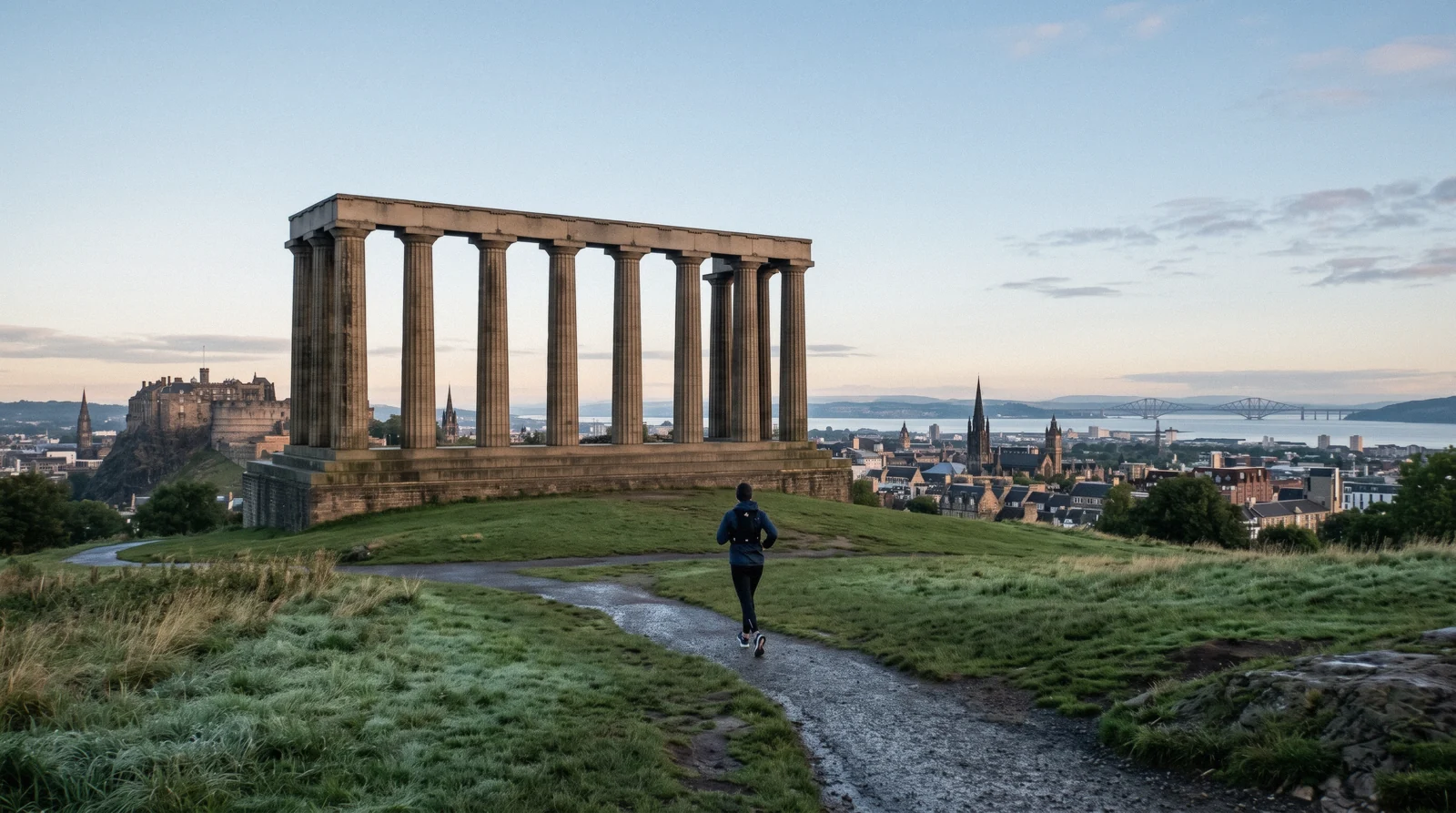
Calton Hill
Calton Hill is the low volcanic stub at the east end of Princes Street where Edinburgh put its Greek temple, its Nelson tower and its first observatory, then argued about all three. It is the city's cheapest good decision: no gate, no ticket, no climb worth the name — a flight of steps from Waterloo Place, ten minutes on foot from Waverley, and the Old Town ridge, the castle rock and the Firth of Forth line up in front of you. The one thing on top that charges is the Nelson Monument, and even its own website cannot agree on what time it shuts. This page has the free part, the paid part, the hour to come for the light, and what to do at the bottom of the steps. It is one stop in our guide to what to do in Edinburgh.
Quick answer Free, unfenced, ten minutes from Princes Street — and one ticket on top
Calton Hill is a free public hill in the middle of Edinburgh: no gate, no ticket, no opening hours, and a stepped path off Waterloo Place that most people walk up in about ten minutes. The monuments on top — the twelve columns of the National Monument, the Dugald Stewart Monument, the City Observatory — cost nothing to stand among. The only charge on the whole hill is the Nelson Monument tower at £7.50 (about $10).
Key takeaways
- The hill is 100 metres above sea level and the walk up is a staircase, not a climb — which is why it, and not the bigger hill across the valley, is the viewpoint to take at the end of a long day. How the two compare is the honest version.
- The Nelson tower charges £7.50 with the climb and £3.00 without it, and its own website prints two different closing times — what we found matters if you are arriving mid-afternoon.
- The one guided walk on the platform that actually comes up here also takes in the bigger hill: three hours over both summits, rated 4.9 from 81 reviews.
- Sunset swings from 15:38 in mid-December to 22:00 in mid-June — the month table sets the hour, and there is a cafe on the summit open until 20:30 for the wait.
Key facts
Opening hours
| The hill itself | No gate, no barrier, no published closing time |
|---|---|
| Nelson Monument | 10:00–16:30 in the venue's opening-times panel, 15:30 in its own venue blurb |
| Collective, City Observatory | Wednesday to Sunday 10:00–17:00; closed Monday and Tuesday |
| Cafe Calton, on the summit | 08:30–20:30 daily |
Closed None for the hill. Collective closes Monday and Tuesday; the Nelson Monument states no closed days
Admission
- Adult
- Free — the hill, the National Monument and the view cost nothing at any hour
- Reduced
- Nelson Monument £7.50 with the tower (about $10) · concession and children 5–15 £6.50 (about $9) · family of four £23 (about $31) · monument without the tower £3.00 (about $4) · Scott and Nelson combined £14 (about $19)
- Free
- Everyone, always, for the hill. Under-5s are not permitted up the Nelson tower at all
Planning it
- Time needed
- Nobody official publishes one. Our routing: 30 to 45 minutes for the hill and the monuments, an hour and a quarter if you add the tower and the galleries
- Book ahead
- Optional — walk-up usually fine
- Address
- Calton Hill, Edinburgh EH7 5AA — Nelson Monument at number 32, the City Observatory at number 38; the stepped entrance is off Waterloo Place
There is no ticket to Calton Hill, so this compares what the hill costs once you are on it: nothing, £3.00 or £7.50 for the tower, or a guide who walks you up both volcanic hills. Official prices are Culture Edinburgh's own, read on 30 August 2026; the guided price is the operator's, from GetYourGuide the same day.
One question decides the row: is the balcony worth paying for? The hill, the columns and the view cost nothing at any hour, and the Nelson Monument is the only thing on the summit with a price.
| Way up | Price | What it covers | Cancel | Book |
|---|---|---|---|---|
| Walk up the steps yourselfThe right choice for anyone who came for the view; the terrace costs nothing | Free | The whole hill, the columns, the observatory grounds and the view, at any hour | — | Official site |
| Nelson Monument, tower includedFor visitors who want the spiral climb, the balcony and the time-ball displays | £7.50 (about $10); £6.50 concession and children 5–15 | The spiral climb to the balcony and the time-ball displays inside the base | Sold at the door, no online booking | Official site |
| Nelson Monument, tower excludedOnly for the displays in the base; it buys no view from the balcony | £3.00 (about $4) | The base and its displays only — the balcony view is not included | Sold at the door, no online booking | Official site |
| Guided walk over both hills, 3 hoursFor a first visit that pairs this summit with Arthur's Seat | £26 (about $35) | A guide, the route over Arthur's Seat and this summit, the history on the way | Free up to 24 hours before | Check Availability |
The official rows link straight to Culture Edinburgh with nothing added to the URL. The guided row is an affiliate link to GetYourGuide: the price is the operator's, we take a commission if you book through it, and it costs you nothing extra. Prices and ratings read on 30 August 2026. Guided prices are listed in pounds on GetYourGuide, with dollar figures at £1 = $1.36.
The guided walks that actually come up here
Worth saying plainly: almost nothing sold as an Edinburgh tour includes this hill, because there is no ticket to resell and no queue to skip. One product on GetYourGuide's Edinburgh page climbs it, and it pairs the summit with the bigger hill across the valley; the other two are the hill-walking alternatives, listed so you can see what the difference in price buys. Prices, ratings and review counts are the operators' own, read on 30 August 2026.
 from £26
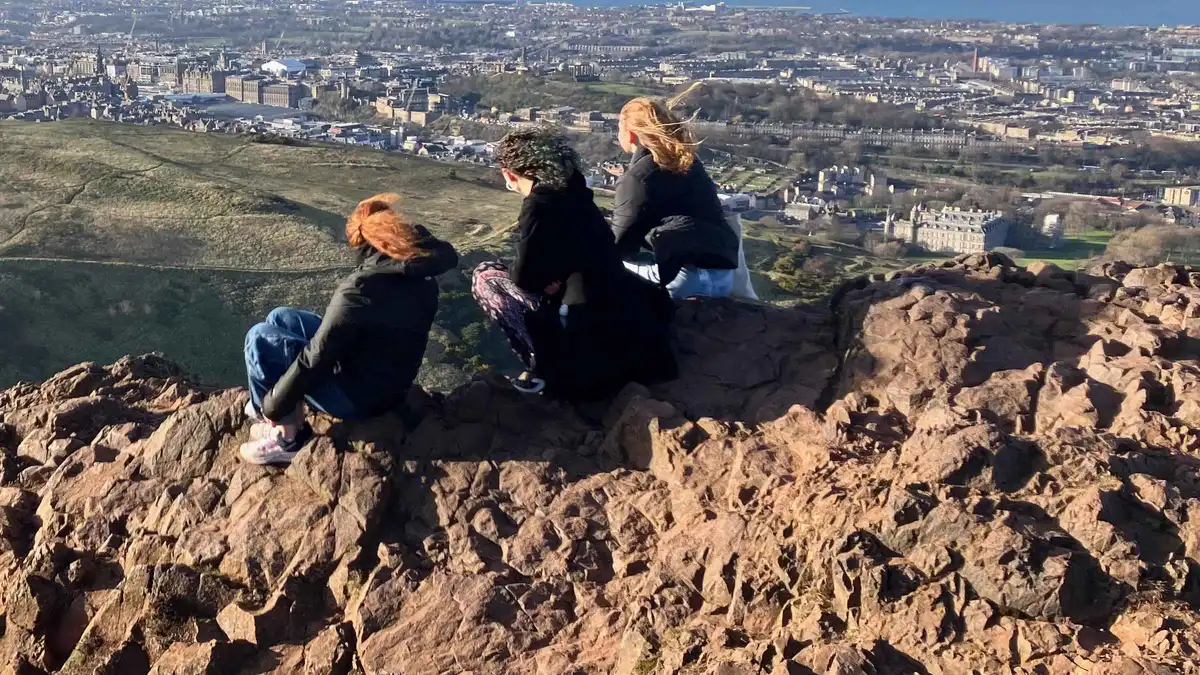
Edinburgh: Hike Arthur's Seat & Calton Hill
Adds Calton Hill and its monuments to the Arthur's Seat climb, four miles end to end across three hours at a gentle pace. Starts at Waterloo Place and finishes at the Holyrood car park.
Check Availability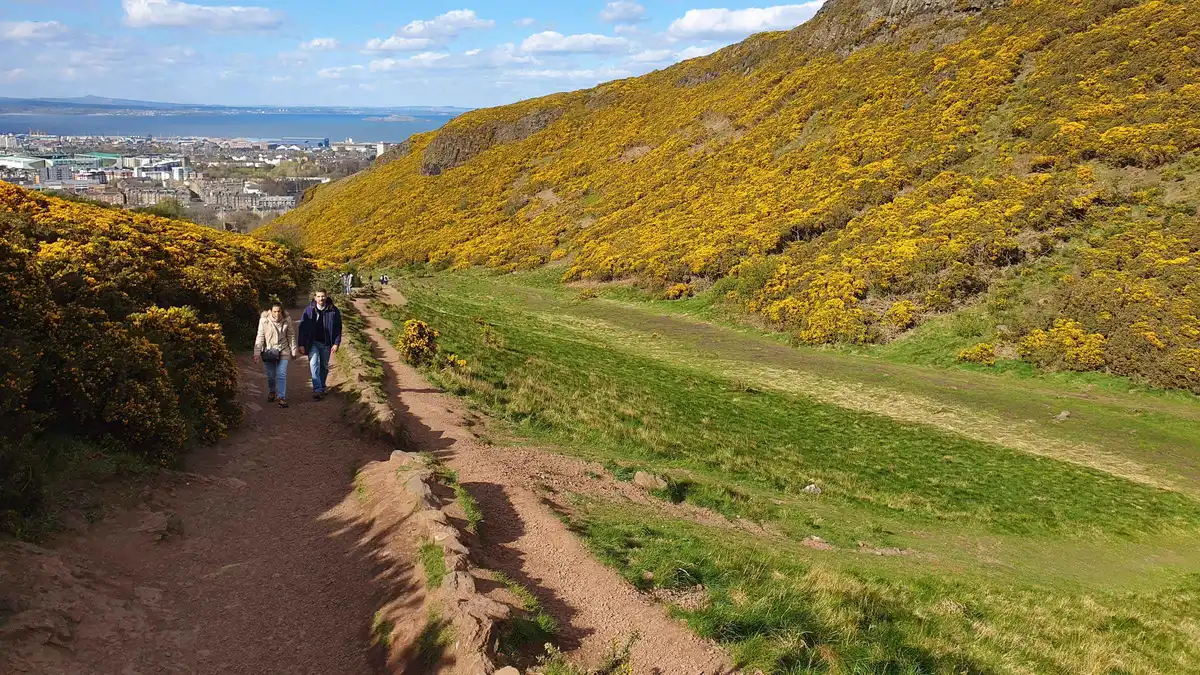 from £24
Edinburgh: Guided Hike to Arthur's Seat and Holyrood Park
Two hours up Arthur's Seat by the local paths rather than the tourist route, with time in Holyrood Park on the way. Bring your own food and water; there are no toilets once you start.
Check Availability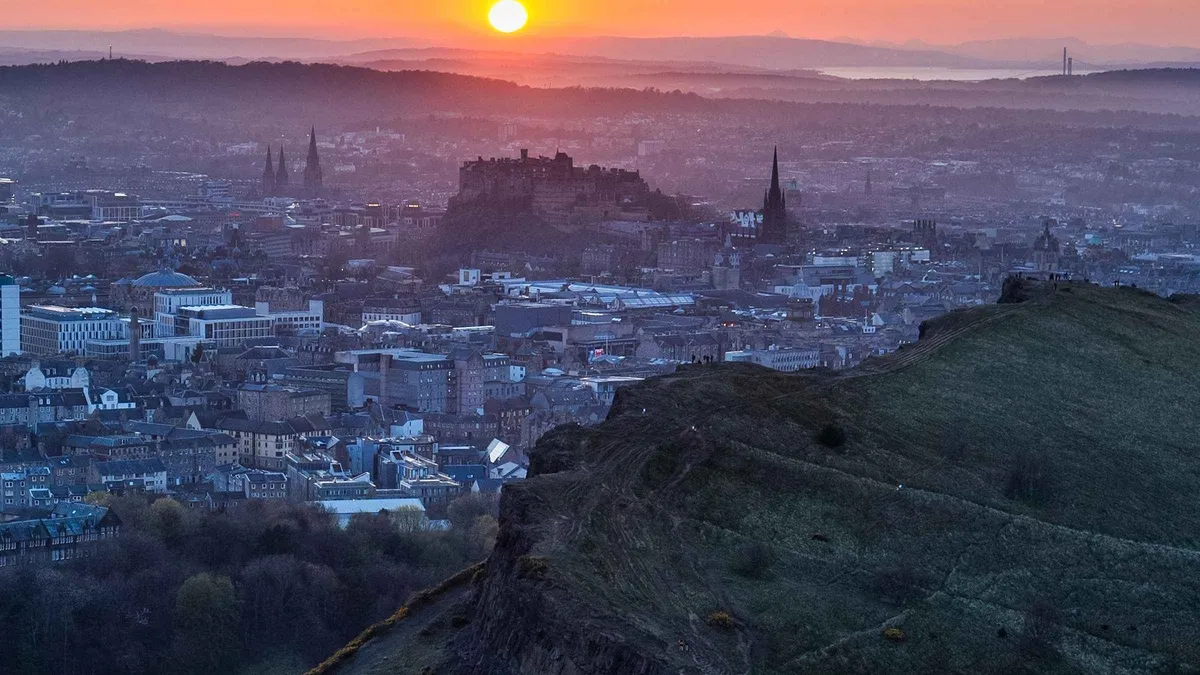 from £45
Arthur's Seat Sunset Hike
Timed so the summit lands at sunset, then a torch-lit descent on a quieter route — that timing is what the higher price buys. Led by a qualified Mountain Leader, 250 metres of climbing.
Check AvailabilityPrices, ratings and details are the platform's own. Pound figures are the listed prices. The platform bills in your account's currency.
The National Monument: the building Edinburgh never finished, and never stopped arguing about
Twelve columns and an entablature, standing on a stone platform with nothing behind them. It is the most photographed unfinished building in Scotland and the reason the hill has a nickname.
The plan was a full-scale Parthenon. It was to be a national memorial to the Scottish soldiers and sailors killed in the Napoleonic Wars, designed by William Henry Playfair with Charles Robert Cockerell, and paid for by public subscription. The subscription ran out. Wikipedia dates the start of construction to 1826 and the halt to 1829; Edinburgh World Heritage dates the start to 1822 — the two sources disagree, and neither the city nor any trust publishes a definitive figure for what was spent. What everyone agrees on is that money stopped in 1829 with twelve columns standing, and that nothing has been added since.
The names came almost immediately: Edinburgh's Disgrace, Scotland's Disgrace, Edinburgh's Folly, the Pride and Poverty of Scotland. Wikipedia's own wording is that those names "have waned given the time elapsed since the Napoleonic Wars and it is now accepted for what it is". That is the modern reading — a ruin that was never a building, sitting in the middle of a UNESCO World Heritage Site, doing the job of a monument better broke than it would have done finished.
Why the columns are the photograph
Practically, this is where people stand. The columns frame the Old Town ridge to the west, the castle sits at the end of it, and the platform is high enough to clear the trees. Come at the end of the afternoon and half the people on the hill are within ten metres of these stones.
You can walk up onto the platform and between the columns — there is no barrier and no supervision, and the stone steps up to it are uneven and have no handrail. It is the one place on this hill where people actually turn an ankle.
'Athens of the North', and where the phrase came from
The columns are the surviving piece of a bigger idea. In the early nineteenth century Edinburgh set out to be the Athens of the North, and Calton Hill was cast as its Acropolis: a classical skyline of temple, tower and observatory above a planned Georgian city. Edinburgh World Heritage puts it as "a peaceful open-air gallery of some of Edinburgh's most important monuments", which is a fair description of what you walk into at the top of the steps.
Playfair's hand is on much of what surrounds it too — the terraces that ring the hill on three sides, Royal Terrace, Carlton Terrace and Regent Terrace, are his, dated 1819. The New Town below them is the other half of the same ambition.
The Nelson Monument: the only ticket on the hill, and its two closing times
An upturned telescope in stone, built between 1807 and 1815 to Robert Burn's design after Nelson's death at Trafalgar. It is the one thing up here you pay for, and the numbers below are Culture Edinburgh's own, read on 30 August 2026.
There are two tickets and the difference matters: £7.50 (about $10) buys the monument and the climb to the balcony; £3.00 (about $4) buys the monument without the tower — the displays in the base, and no view.
| Ticket | Price | Approx. USD | What you get | Where you buy it |
|---|---|---|---|---|
| Adult, tower included | £7.50 | $10 | The base displays and the climb to the balcony | At the door on the hill |
| Concession / child 5–15 | £6.50 | $9 | The same, at the reduced rate | At the door on the hill |
| Family, four people | £23 | $31 | Two adults and two children, or one adult and three | At the door on the hill |
| Adult, tower excluded | £3.00 | $4 | The base and its displays only — no view | At the door on the hill |
| Scott and Nelson combined | £14 | $19 | Both towers, saving £2.50 against two singles | At either monument's desk |
Concessions and children aged 5 to 15 pay £6.50 (about $9), a family of four is £23 (about $31), and a combined ticket with the Scott Monument down in Princes Street Gardens is £14 (about $19), which saves £2.50 on two separate tower tickets. Children under five are not permitted up the tower at all.
Here is the thing to plan around. Culture Edinburgh's opening-times panel for the venue says 10:00 to 16:30. The venue blurb on the same website says, in its own words, "Open 7 days a week from 10am to 3:30pm." We re-read the page on 30 August 2026 and both statements were still live. No last-entry time is published anywhere on it. Treat 15:30 as the closing time you plan for and 16:30 as a bonus if the door is still open — and if the tower is the reason you are climbing the hill, do not make it the last stop of the afternoon.
The time ball, and the gun across the valley
A white time ball was fitted to the mast on top of the tower in 1853 so that ships in Leith could set their chronometers by it. It is still lowered every day at one o'clock, at the same moment the gun fires from the castle rock — the two were wired together, and the displays inside the base tell the story of Charles Piazzi Smyth, the Astronomer Royal for Scotland who set it up.
That is the free version of the trick worth knowing: stand on the hill just before 13:00 and you can watch the ball drop here and hear the gun arrive from a mile away, slightly late, which is the sound of the speed of sound. What happens at the castle end of it is on the castle page.
Getting inside it
Access is described by the venue as "access with steps": two steps at the main entrance, no lift, no ramp, and the upper levels by stairs only. Lighting is low in places. Braille and large-print information is available, visit guides are printed in German, French and Spanish, and personal assistants get a complimentary ticket.
Nobody official publishes a step count for the climb — one widely copied guide site says 170, and we could not confirm it from Culture Edinburgh's own pages, so treat it as folklore rather than a figure. The balcony is narrow and it is a spiral, so on a busy afternoon you queue on the stairs.
What else is up here: an observatory, a gallery, a burial ground and a cafe
The columns and the tower are what people photograph, but the summit is a small compound of buildings and most visitors walk past three of them. Hours below are the venues' own, read on 30 August 2026.
The City Observatory is now Collective, a contemporary art gallery, and it is open Wednesday to Sunday 10:00 to 17:00 — closed Mondays and Tuesdays, which is the trap for anyone planning a rainy indoor half hour on the wrong day. Its own visit page lists no admission charge. The site is at 38 Calton Hill and includes the old observatory building, the City Dome and a newer building called The Hillside; accessible toilets are available on request at the City Observatory and The Hillside.
The observatory's history is older than the gallery: Edinburgh World Heritage dates the Gothic Observatory House to 1776, the city's first. In 1787 the artist Robert Barker, walking on this hill, was inspired to invent the panorama — the world's first, a 360-degree painting of Edinburgh taken from the observatory tower. The view that made it is the one you are standing in.
- Dugald Stewart Monument — the small circular temple on the western shoulder. It is the postcard: the Old Town, the castle and the spires line up behind it, and it is free to walk right up to.
- Political Martyrs' Monument — the obelisk in the Old Calton Burial Ground below, for five reformers convicted of sedition and transported to Botany Bay in 1793.
- Old Calton Burial Ground — on the south-western slope, and the resting place of the philosopher David Hume, whose tomb carries only the years 1711 and 1776.
- St Andrew's House — the 1930s block on the steep southern slope, headquarters of the Scottish Government, built on the site of the demolished Calton Jail; the jail's Governor's House still stands beside it.
- Robert Burns Monument — on the Regent Road side, a circular temple in the same classical family as the rest.
Coffee, and the sunset wait
Two places to sit on the summit, plus the galleries, and their hours are the thing that decides a sunset plan: Cafe Calton covers a late June evening, Collective's counter does not. All read from the venues' own listings on 30 August 2026.
| On the summit | Open | Closed | Why it matters |
|---|---|---|---|
| Cafe Calton | Daily 08:30–20:30 | — | The only thing up here that covers a 22:00 midsummer sunset |
| Collective galleries, City Observatory | Wednesday to Sunday 10:00–17:00 | Monday and Tuesday | No admission charge listed — the indoor twenty minutes when it rains |
| Collective coffee counter | Wednesday to Sunday 10:00–15:30 | Monday and Tuesday | Shuts long before the evening light |
| Accessible toilets | On request at the City Observatory and The Hillside | Outside gallery hours | There are no public toilets on the hill otherwise |
There is no shop, no visitor centre and no ticket office on the hill. The two accessible toilets are at Collective and The Hillside and are offered on request, which in practice means during gallery hours.
How to get to Calton Hill, and which way up
The hill sits at the east end of Princes Street, between the Old Town and the port road, and it is within walking distance of everything in the centre. Fares are Lothian's and Edinburgh Trams' own, read on 30 August 2026.
The main way up is the long flight of stone steps off Waterloo Place, the continuation of Princes Street past the Balmoral. From Waverley station that is about eight minutes of level walking plus the steps; from St Andrew Square, about ten.
| Coming from | How | Time (our estimate) | Cost |
|---|---|---|---|
| Waverley station | On foot up Waterloo Place, then the steps | About 10 minutes | Free |
| The west end of Princes Street | Level walk the length of the street, then the steps | About 20 minutes | Free |
| The bottom of the Royal Mile | Up Calton Road or round by Regent Road | About 12 minutes | Free |
| Anywhere on the tram line | Tram to St Andrew Square or Picardy Place, then walk | Tram journey plus 10 minutes | £2.40 city single (about $3.30) |
| By Lothian bus | Any service to Princes Street or Leith Walk | Ride plus 10 minutes | £2.40 single, £6.00 day (about $3.30 / $8.20) |
Steps also climb from Royal Terrace on the north side, and Regent Road runs round the southern flank with a gentler paved approach from the east.
There is no public vehicle access to the summit: Collective's visit page states that vehicle access is restricted except for disabled visitors. If step-free access matters, that is the route to arrange in advance, and the Regent Road side is the level one. The nearest tram stops are Picardy Place and St Andrew Square — the tram is running its full route, at up to every seven minutes, on the operator's own live status page read on 30 August 2026.
The fare detail that saves money
Tapping the same contactless card on Lothian buses all day caps at £5.70 (about $7.75), which is 30p less than buying the paper day ticket — but capping only works through the operator's Tap Tap Cap system, and plain contactless on board just buys singles. Cash on board must be exact; drivers give no change. How the tickets and caps work has the rest.
Honestly, though: this is a hill you walk to. Any fare you pay to reach it is a fare you did not need to pay.
Sunrise, sunset and the hour to come
This is the hill people plan around the clock rather than the calendar. Sunrise and sunset below are computed for the summit's own coordinates, 55.9543 N, 3.1826 W, for 2026, with British Summer Time applied between 29 March and 25 October. Times are for the 15th of each month.
Read the swing before you set an alarm. Mid-June gives a sunrise at 04:26 and a sunset at 22:00; mid-December gives 08:38 and 15:38.
| Month | Sunrise (15th) | Sunset (15th) | What that means up here |
|---|---|---|---|
| January | 08:33 | 16:10 | Sunset before the shops shut — the easiest golden hour of the year to catch |
| February | 07:37 | 17:16 | Cold, clear and almost empty; wind is the reason people leave |
| March | 06:27 | 18:15 | Clocks go forward on 29 March and the evening jumps an hour |
| April | 06:06 | 20:18 | Long light, dry-ish ground, the quietest of the good months |
| May | 04:59 | 21:18 | Late evenings begin; the cafe until 20:30 starts to matter |
| June | 04:26 | 22:00 | A 22:00 sunset and a 04:26 sunrise — the shortest night to plan against |
| July | 04:48 | 21:48 | Peak crowd month; the columns are a photo queue before sunset |
| August | 05:44 | 20:50 | Festival month, and the busiest evenings on the hill all year |
| September | 06:44 | 19:31 | The best trade-off: warm light, workable hours, thinning crowds |
| October | 07:44 | 18:12 | The wettest month in the city's 30-year averages, at 89.9 mm |
| November | 07:49 | 16:05 | Dark by teatime; the hill is unlit, so come with a torch |
| December | 08:38 | 15:38 | Sunrise after breakfast and sunset before dinner — the lazy option |
In winter, sunset here is an after-work event you can reach in your work clothes; in June it is close to midnight-feeling light, and the hill stays busy until well after the sun has gone.
Which end to take depends on what you want in the frame. The Old Town ridge and the castle sit west of the hill, so sunset puts the light behind them and the city in silhouette — the classic shot, and the crowded one. Sunrise comes up over Leith, the Firth of Forth and the Fife coast to the east and north-east, lights the columns from the side, and you will often have the summit to yourself.
After dark, honestly
The paths are unlit, the steps are uneven, and the hill has a long history of night-time incidents reported in the Scottish press. None of that makes it a no-go — people are up here at sunset every evening of the year, and in August it is busier at 22:00 than most streets — but the sensible version is to stay with the crowd, use the Waterloo Place steps rather than the dark side of the hill, and come down when the last group does. Carry a torch rather than relying on a phone.
If you want the sunset with company and someone who knows the ground, the guided walk over both hills covers this summit and the bigger one, and the sunset hike with a Mountain Leader does the other hill at the golden hour.
Calton Hill or the bigger hill: which viewpoint to spend your evening on
Google asks this question more often than any other about this hill, so here is the straight answer with the reasons attached.
Take Calton Hill if you have an hour, if you are in city shoes, if the weather is uncertain, if someone in the party does not walk far, or if you want the photograph of the castle and the Old Town ridge. It is roughly 100 metres above sea level, the ascent is a staircase, and you are back on Princes Street ten minutes after you decide to leave.
Take Arthur's Seat if you have half a morning and want the walk to be the point: 250.5 m, 45 to 60 minutes up from the Palace end, bare rock at the top and the whole of Lothian around you. It is a different kind of outing — a hill walk with a view at the end, rather than a viewpoint with steps.
The honest catch is that the famous Edinburgh skyline photograph — castle, ridge, spires, all in one frame — is taken from here, not from there. From the bigger summit you are looking down on a city that has become a map. If you only do one and the photo is what you came for, this is the one. If you want both in one outing, the three-hour guided walk links them for £26 (about $35).
Fire festivals, and the days the hill is not yours
Twice a year this becomes a ticketed event space, and once a year it fills with several thousand people after dark.
The Beltane Fire Festival takes over the summit on the night of 30 April and draws over 12,000 people. Samhuinn, its winter counterpart, runs at the end of October, and the Dussehra Hindu festival is held on the hill near the beginning of October. On those evenings the hill is not a quiet viewpoint and access is managed — check the organisers' own pages before planning a sunset around those dates.
The rest of the calendar is ordinary, with one seasonal caveat worth knowing: during the August festival weeks this is one of the busiest outdoor spots in the city centre, and the hour before sunset is standing room among the columns. When to come to Edinburgh at all has the wider picture.
Calton Hill map: the monuments, the steps and the way in
The five things worth walking to on the summit, plus the stepped entrance off Waterloo Place. Monument positions are from Wikidata and the venues' own addresses; the entrance pin is approximate to within a minute's walk.
What to do at the bottom of the steps
Walking times are our estimates from the Waterloo Place entrance.
The Royal Mile
Down Calton Road or round the North Bridge and you are at the bottom half of the street. The Royal Mile page runs it end to end, close by close.
12 min walkPalace of Holyroodhouse
The natural pairing for a morning: the free hill first, then the ticketed hour indoors. The Palace page has the hours, the royal closure dates and what the ticket covers.
15 min walk downhillArthur's Seat
The other volcanic stub, four times the height and a proper walk. The routes and times are on its own page, and the guided walk that does both links them in three hours.
25 min walk to the park gateCalton Hill questions
Is Calton Hill free to visit?
Yes. The hill is an unfenced public hill with no gate, no ticket and no published opening hours, and the National Monument, the Dugald Stewart Monument and the whole view cost nothing at any hour. The only charge on the summit is the Nelson Monument at £7.50 (about $10) with the tower or £3.00 (about $4) without it — the price table has the concessions and the family rate.
How long does it take to walk up Calton Hill?
About ten minutes from Waverley station, most of it level walking along Waterloo Place, then a flight of stone steps that takes two or three minutes at an unhurried pace. Nobody official publishes a time or a step count — those are our estimates. Allow 30 to 45 minutes on top for the monuments and the view, or a good hour and a quarter if you add the tower and the galleries. Which way up compares the approaches.
Why is Calton Hill famous?
For two things. It carries the classic photograph of Edinburgh — the Old Town ridge, the castle and the spires, framed between neoclassical monuments — and it carries the country's most famous unfinished building, the twelve-column National Monument that ran out of money in 1829. It is also inside the city's UNESCO World Heritage Site. The story of the columns has the dates and the nicknames.
Can you climb the Nelson Monument, and what does it cost?
Yes, with the £7.50 ticket (about $10); the £3.00 ticket buys the base displays without the climb, which catches people out. Tickets are sold at the door on the hill, not online. Children under five are not permitted up the tower, access is by stairs only with two steps at the entrance, and Culture Edinburgh's own site prints two different closing times — what we found on the day is worth reading before you time your afternoon.
When is the best time of day to go up Calton Hill?
Sunset for the photograph, sunrise for the quiet. The city's landmarks sit west of the hill, so the evening light falls behind them and the Old Town goes to silhouette; the morning sun comes up over Leith and the Firth of Forth and lights the columns from the side with nobody else there. Sunset ranges from 15:38 in mid-December to 22:00 in mid-June — the month table has all twelve, and the summit cafe stays open until 20:30.
Is Calton Hill worth visiting?
For the ratio of effort to view, it is the best half hour in central Edinburgh: ten minutes from Princes Street, no ticket, and the skyline that ends up on postcards. The caveat is that it is small — you will have seen it in 45 minutes, and it has no shop, no visitor centre and one cafe. If you want the walk to be the outing rather than the viewpoint, the bigger hill across the valley is the comparison to read.
Is there parking on Calton Hill?
Not for visitors. Vehicle access to the summit is restricted to disabled visitors, as Collective's own visit page states, and everyone else walks up from Waterloo Place, Royal Terrace or Regent Road. Street parking around the terraces is residential and controlled. The tram stops at St Andrew Square and Picardy Place are about ten minutes away on foot — getting there has the fares.
The version of this that works
Do it at the end of the day, not the start. Walk the length of Princes Street in the late afternoon, up the Waterloo Place steps, and be among the columns half an hour before the sunset time in the month table. Pay the £7.50 for the tower only if you arrive before mid-afternoon, given the two published closing times, and take the £3.00 ticket off the list entirely — it buys the one part of the monument without a view.
If it is a Wednesday to Sunday and the weather turns, Collective in the City Observatory gives you an indoor twenty minutes with no admission charge listed, and Cafe Calton runs to 20:30 for the wait. Then walk down the far side to the bottom of the Royal Mile and have dinner in the Old Town, which is ten minutes downhill and the natural next move.
The rest of the city, with the same hours-price-map treatment on every page, starts from our guide to Edinburgh attractions.
Calton Hill on film: the walk up, the columns and the view
Three walk-throughs that show what the top actually looks like — how short the climb is, how close the monuments stand to one another, and what the skyline does in good light. Ids copied from our verified list, embedded without cookies.
Why you need to go to Edinburgh's Calton Hill
The case for the hill in a few minutes, filmed on the summit among the monuments.
Video: Scotland UnpluggedExplore Calton Hill: a must-visit destination in Edinburgh
A 4K walk across the summit, which is the quickest way to see how small and how compact the top is.
Video: Sounds and VistasA scenic tour of Calton Hill: Nelson Monument and the National Monument
Both monuments and the panorama between them, useful if you are deciding whether to pay for the tower.
Video: World Travel WalkThird-party videos. Neither the channels nor the videos are connected to this site.
Prices, hours and terms are set by the venue or operator and confirmed at checkout.
We may earn a commission if you book through one of our links, at no extra cost to you. Full affiliate disclosure